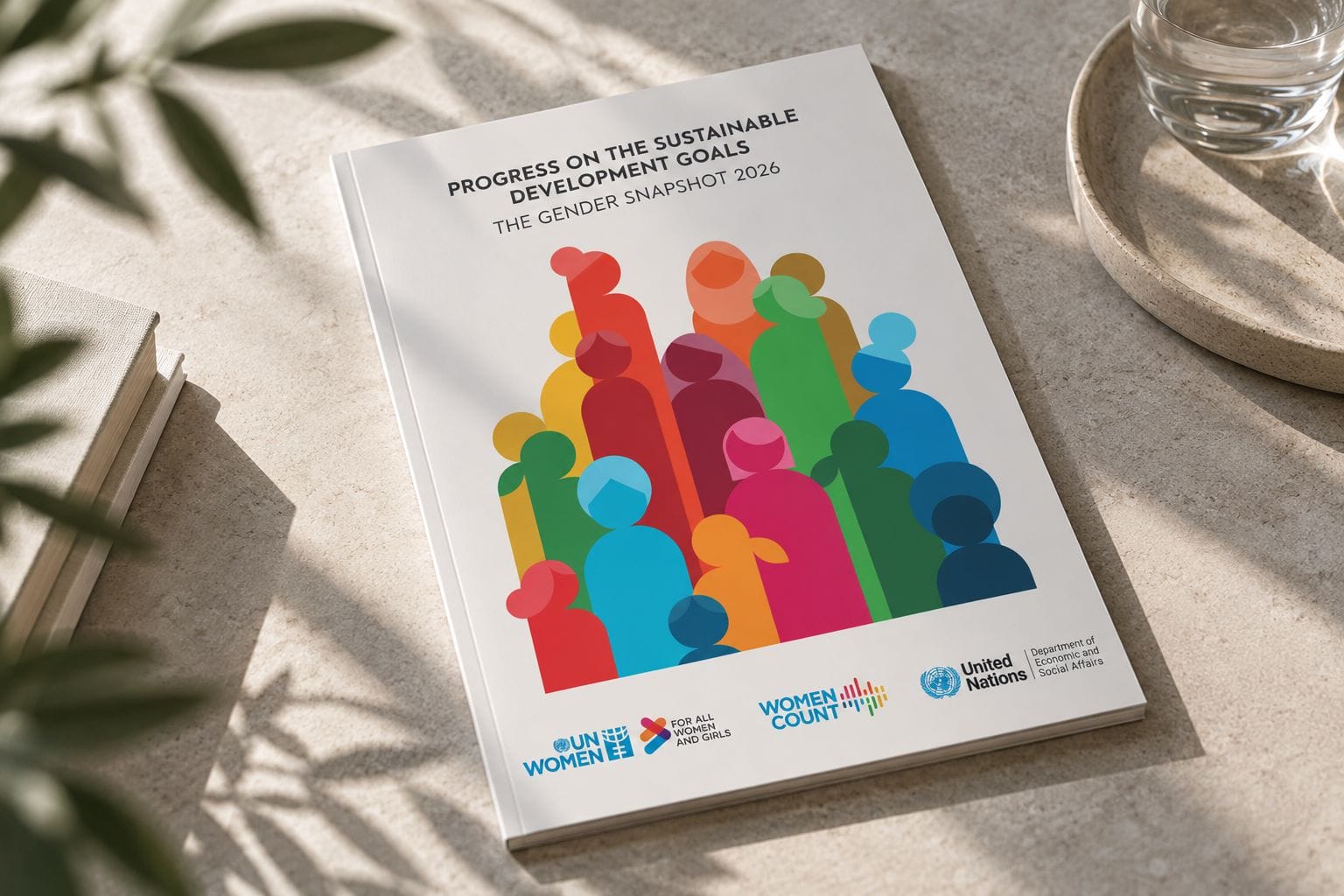
Two major reports on gender equality were published back to back on 16 and 17 September 2026. The World Economic Forum’s (WEF) Global Gender Gap Report 2026 report examines how the gap between women and men has changed over twenty years of data. UN Women and the United Nations Department of Economic and Social Affairs’ (UN DESA) The Gender Snapshot 2026 report, meanwhile, assesses all of the Sustainable Development Goals from a gender perspective.
The two reports use different methodologies. But when read together, an important pattern emerges: progress on equality is being made, but the pace of that progress varies widely across areas. There are also signs of weakening capacity among the institutions responsible for implementing equality policies.
What Do Twenty Years of Data Show?
WEF first published the Global Gender Gap Index in 2006. The index measures the gap between women and men across four areas: economic participation and opportunity, education, health and political empowerment.
The 2026 report assesses 145 economies. Across these economies, 69.2 percent of the global gender gap has been closed. Looking at the 97 economies tracked continuously since 2006, the figure has risen from 64.2 percent to 69.4 percent, a gain of 5.2 percentage points over twenty years. If the current pace of progress continues, reaching overall parity will take 120 years.
But the overall average does not reveal the significant differences between areas.
As of 2026, 96.2 percent of the gender gap in health and 96.9 percent in education have been closed. The figure drops to 61.7 percent in economic participation and opportunity, and to 22.1 percent in political empowerment.
This data has an important implication: Coming close to equality in education and health does not automatically produce the same result in economic and political decision-making mechanisms.
According to WEF’s calculations, if the current trend continues, achieving parity will take 129 years in economic participation and opportunity, and 194 years in political empowerment.
Why Is Progress on Political Empowerment Fragile?
Political empowerment remains the area furthest from parity in the WEF index.
Across the 97 economies tracked continuously since 2006, the political empowerment score rose from 14.4 percent to 22.4 percent. This eight-point gain is the largest twenty-year improvement among the four main dimensions. Even so, political empowerment is the area that will take longest to reach parity at the current pace.
Recent progress has not been linear, either.
Among the economies common to both the 2025 and 2026 reports, the political empowerment score fell from 22.5 percent to 22.1 percent. Another indicator WEF highlights is that women’s representation in national leadership has fallen back from its 2022 peak to 2016 levels.
So while the twenty-year trend is positive, these gains cannot be assumed to be permanent.
Is Representation the Same as Influence?
Another notable distinction in WEF’s 2026 report is the gap between women’s access to senior positions and the decision-making power those positions actually carry.
Women today hold more positions in corporate leadership and government than they did in 2006. But their representation is lower in the positions carrying the greatest economic and political influence.
According to WEF data, women hold 19.1 percent of CEO positions. Of the ministerial portfolios held by women, only one in ten is considered high-influence.
This distinction matters for how representation data should be interpreted.
Counting the number of women on a board or in a public institution is one indicator. Assessing how much authority they hold over budgets, investment, the economy, security or other strategic decision areas is another.
Tracking equality therefore cannot rely on the question “how many women are there?” alone. It is also necessary to look at how decision-making authority and institutional influence are distributed.
What Is the State of the Institutions Responsible for Equality?
The Gender Snapshot 2026, published a day after the WEF report, adds an important data point on institutional capacity.
In a 2026 survey of 54 national gender equality mechanisms across seven regions, 32 percent of institutions reported an erosion of institutional power over the past two years. UN Women and UN DESA assess the practical consequences of this in terms of reduced funding, lower accountability and a growing risk of weaker implementation of existing commitments.
It is important to assess the scope of this data accurately. The survey is not a global census covering every equality institution in the world; it is based on 54 national mechanisms from seven regions. The 32 percent figure therefore cannot be generalized directly to all countries.
Even so, the finding points to a significant institutional problem.
The existence of a ministry, public institution or other national mechanism responsible for gender equality in a given country does not mean that institution is able to function effectively.
Institutional capacity depends not only on legal authority but also on factors such as budget, staffing, institutional status, access to decision-making processes, and the capacity to produce and monitor data.
An institution can continue to exist in law while losing its influence in practice.
The Gap in Decision-Making Mechanisms Persists
Other indicators in the Gender Snapshot 2026 also show that the gap in institutional power and decision-making persists.
According to the report, at the current pace of progress, reaching equal representation in national parliaments could take 63 years. A significant representation gap exists in the higher judiciary as well: of 175 chief justices examined worldwide, 144 are men and 31 are women.
When these figures are considered alongside WEF’s political empowerment indicators, two distinct problems emerge.
The first is the gap in women’s access to decision-making positions.
The second is whether the institutions responsible for advancing equality and protecting existing gains actually have the capacity to do so.
This second question moves the equality debate directly into the domain of governance.
The Gap Between Legal Authority and Institutional Capacity
Recognizing a right in legislation is one of the necessary first steps toward that right being exercised effectively in practice. But putting it into practice also requires institutional infrastructure.
This distinction is visible across different areas of gender equality.
The principle of equal pay may be enshrined in law, but if pay systems are not monitored, unexplained gaps become harder to detect.
A prohibition on discrimination may exist, but if there are no effective mechanisms for employees or citizens to appeal to, exercising that right becomes difficult.
Representation in decision-making bodies may increase, but if authority continues to be concentrated in certain positions, numerical representation may not translate into a proportional increase in influence over decisions.
For this reason, assessing institutional capacity requires looking not only at whether institutions exist, but at how effectively they are able to function.
Budget autonomy, adequate staffing, clear responsibilities, access to data, regular monitoring, transparency and accountability are among the core elements of this capacity.
What Does This Mean for Companies?
The same assessment applies to the private sector.
The fact that the education gap has largely closed in WEF’s data, while the parity figure for economic participation and opportunity remains at 61.7 percent, shows that gains in education are not translating into working life and economic decision-making to the same degree.
For companies, this gap can surface across a range of processes, from hiring to compensation, from promotion to access to senior management, and from performance evaluation to board composition.
Assessing corporate equality policies therefore requires tracking several core indicators together: women’s overall share within the organization, their representation at management levels, pay gaps, promotion rates, access to decision-making positions, and the effectiveness of the mechanisms through which employees can raise discrimination or inequality claims.
Here too, the gap between policy and practice matters.
A company publishing an equality policy is not the same thing as that policy producing measurable results in pay, promotion and management decisions.
Where Does Dispute Management Fit Into This Structure?
Another element of institutional capacity is how emerging disagreements and inequality claims are handled.
Having channels through which employees can safely raise concerns about pay, promotion, discrimination or working conditions matters for resolving issues at an early stage.
Grievance mechanisms, negotiation, facilitated dialogue and, where appropriate, mediation can all be part of this structure.
But resolving an individual dispute needs to be distinguished from addressing structural problems. Resolving one employee’s dispute does not remove the need to examine whether the same issue exists systematically within the organization.
Effective dispute management should therefore be understood not as a substitute for corporate equality policy, but as a governance mechanism that supports it.
The Durability of Equality Depends on Institutional Capacity
The 2026 data show that meaningful progress on gender equality has been made over the past twenty years. Among the 97 economies WEF has tracked continuously since 2006, the overall equality score has reached its highest level on record.
That said, progress is not balanced across areas. While the gap has largely closed in education and health, significant gaps persist in economic participation and, in particular, political empowerment. Some political indicators have also shown a decline in recent years.
UN Women and UN DESA’s 2026 findings add another dimension to the discussion: the capacity of the institutions responsible for implementing equality goals must also be protected.
Going forward, assessing gender equality will therefore require more than looking at targets and outcome indicators alone. The budget, authority, staffing, influence over decision-making, monitoring capacity and accountability of the institutions tasked with implementing these goals are also indicators that need to be tracked for the sustainability of equality.
The core conclusion of twenty years of data is that progress is possible. The warning added by the 2026 data is that this progress is not automatically permanent.
Sustainable Development Goals
Sources
UN Women & UN DESA, The Gender Snapshot 2026
World Economic Forum, Global Gender Gap Report 2026
World Economic Forum, Twenty Years of Progress on Gender Parity Now Fragile (press release)
UN Women, press release on the capacity of national gender equality institutions, 17 September 2026