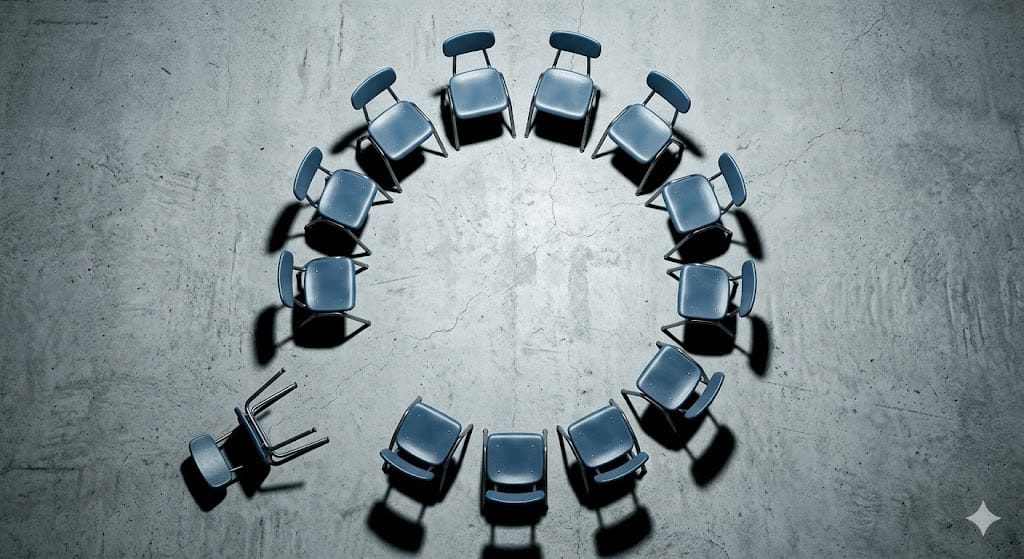
The massacre in Kahramanmaras did not merely expose a security failure. It made visible a deep social fracture that has been accumulating for years, one we have struggled to name.
A day after a school attack in the Siverek district of Sanliurfa left 16 people wounded, a 14-year-old student carried out a shooting at a middle school in Kahramanmaras. Nine people were killed, 13 were injured. These two events emerged within a strikingly short interval, on similar ground. They cannot be treated as isolated incidents.
At ADR Istanbul, we will not approach these events as breaking news. The question of what happened is already answered. The questions that matter are different: How did these children reach this point? And when we look at the system, why are we not surprised?
In earlier pieces we examined the fact that 3 in 4 children in Turkey have been exposed to bullying, either as a victim or a witness. In our analysis Fear of a Futureless Generation: What Young People Think and Feel, the same pattern was unmistakable. Kahramanmaras sits at the intersection of both.
The Anatomy of Rage: How Does a Child Reach This Point?
The digital traces left by the perpetrator suggest this cannot be reduced to a security problem alone. Those traces point to possible contact with online radicalization currents. At the core of such ideologies lies a deepening rage toward the world, a self-positioning as victim, and an belief system that ultimately legitimizes expressing that rage through violence.
This is not unique to Turkey. Profiles of school shooters in Western contexts reveal strikingly consistent patterns: social isolation, peer rejection, digital radicalization, and a desperate desire to be seen, if only for a moment. The tools change, the geography changes; the underlying dynamics do not.
The question that matters: When did these children become invisible?
We Have Said This Before: Bullying Stays Hidden
Data we shared in a 2025 post pointed to the following: 23% of children across Turkey are systematically subjected to peer bullying. 50% have witnessed it. Only 24% remain outside this cycle.
Bullying begins at school in 95% of cases. The first steps are usually verbal: mockery, exclusion, nicknames. Schools tend to minimize these signs and withhold intervention until physical violence occurs. Yet verbal bullying is equally destructive.
“I try not to cry too much. I looked it up on Google — apparently crying too much kills brain cells.”
These words belong to a child documented in field research on bullying.
A child afraid to cry. A child turning to Google for comfort.
When we shared this before, we asked one question:
Who was listening?
Digital bullying ranked as the most feared form in the same research. Threats, ridicule, and exclusion now flow through screens; the home is no longer a safe space. The anger generated at school grows online; the rage generated online returns to school. The cycle feeds itself across both environments.
The Silence of the System
In an independent survey conducted across Turkey in March 2026, 93.1% of respondents said schools were not taking adequate measures for students known to be at risk of violence. That is near unanimity.
But the problem goes beyond insufficient measures. Schools currently lack the capacity to observe children in any holistic sense. Counselor numbers are symbolic; psychological support services exist on paper. There is no early warning mechanism capable of noticing which digital environments a child has entered, which belief systems have taken hold, or what a child is feeling.
UNESCO data places this in an international frame: students who experience bullying are twice as likely to suffer loneliness and suicidal ideation. This is not a problem exclusive to Turkey; but Turkey’s system does not yet have the infrastructure to contain it.
The dominant institutional reflex has been punitive: transfers, suspensions, grade penalties. International research has repeatedly demonstrated that this approach does not work. Zero-tolerance policies push students out of school, deepen the isolation of those who already feel excluded, and create the conditions for violence to reproduce itself.
The Broader Picture of Young People
In our Fear of a Futureless Generation analysis, the data showed: 22% of young people in Turkey now describe themselves as unhappy or very unhappy. In 2015 that figure was 9%. In a decade, it has nearly two and a half times.
8 in 10 young people believe their fundamental freedoms are under threat. Half of those aged 17 to 25 cannot plan beyond a five-year horizon. Disconnection from cultural life, economic uncertainty, social isolation, and psychological fragility: these four axes define a generation.
The child in Kahramanmaras fell to the furthest extreme of this picture. But this picture does not belong to him alone. It is the reality millions of children inhabit, at varying degrees of severity.
Repair, Not Punishment: Alternative Dispute Resolution in Schools
The first responses that come to mind after Kahramanmaras tend to be security cameras, metal detectors, more personnel. Some of these are necessary. None of them are sufficient, because none of them touch the relational breakdowns that generate violence.
Alternative dispute resolution methods enter precisely here. Rather than handling school conflict through punishment mechanisms, they work through processes of repairing relationships and taking responsibility. Known in international literature as restorative practices, these approaches have been studied extensively over the past two decades and have produced meaningful results.
Restorative Circles
The most widely used ADR tool is the restorative circle. The parties to a conflict sit in a circle with a designated facilitator; each speaks in turn, listens, and expresses what they have experienced. The goal is not to determine guilt but to understand harm and repair it.
In cases of minor disputes, exclusion, and verbal bullying, restorative circles offer a functional path for children on both sides of the dynamic. Research shows measurable effects on empathy development and self-regulation skills.
Peer Mediation
Another significant tool is peer mediation. Students trained for this role act as neutral third parties in conflicts among their peers. The model’s strength lies in the fact that the intervention comes from the peer group rather than adult authority, which increases both credibility and ownership.
An independent decade-long study of Chicago Public Schools found that schools implementing restorative practices saw a 35% reduction in student arrests on school grounds and an 18% reduction in out-of-school suspensions. The same study found measurable improvements in students’ sense of belonging and perceptions of school safety.
Restorative Conferences
In more serious cases involving physical violence or severe bullying, restorative conferences bring together the victim, the perpetrator, their families, and the broader school community. With a professional facilitator, the dimensions of harm are discussed and a repair plan is built through collective participation.
Punishment is not the objective. Taking responsibility, acknowledging harm in retrospect, and rebuilding the relationship are. In evaluations conducted by the UK Department for Education, whole-school restorative approaches received the highest effectiveness rating for bullying prevention; 97% of surveyed schools found them effective.
What Does This Mean for Turkey?
These methods have not yet been implemented systematically in Turkey. Some individual schools have made attempts, but none have crystallized into comprehensive school-wide policy. Yet restorative practices generate real impact only when they are treated not merely as a conflict management technique but as a relational and cultural philosophy that encompasses the entire institution.
The foundational steps for putting these approaches into practice are clear. The starting point is training teachers and school administrators as facilitators; the next step is teaching peer mediation skills to students. This does not require additional budget. It requires the right transfer of competence. Developing structured support models for institutions in this area is a critical need.
Redefining What a School Is For
Restorative practices alone are not enough. For them to work, schools themselves must transform.
A school must be not only a place that transmits knowledge but an institution that sees the whole child. School counselors must function in a real and meaningful sense rather than remain a symbolic staffing category. Digital literacy must enter the curriculum, and awareness of online radicalization patterns must be part of that literacy.
And perhaps before all of this: learning to see these children. When a child is turning to Google for comfort, when a child is being drawn into online ideologies of rage, when a child is growing more isolated at school, there need to be adults present who notice in time. This is not a technology problem. It is a problem of attention.
We must state it plainly, one more time: this burden belongs not to children but to adults. Not only to families, but to schools, to society, and to institutions.
Kahramanmaras is not an ending. It is a signal. To call it isolated is the easiest way to ignore that signal. We choose not to look away.
References and related work
Fear of a Futureless Generation: What Young People Think and Feel, ADR Istanbul
Areda Survey, School Violence Research, March 2026
TOG and KONDA, If Turkey Were 100 Young People Report, 2025
UNESCO, Behind the Numbers: Ending School Violence and Bullying, 2019
University of Chicago Education Lab, Restorative Practices in Chicago Public Schools, 2022
Frontiers in Education, Restorative Practices in Reducing School Violence, 2025